

You check into a luxury hotel in New York City and walk up to the concierge desk. “Can you get me a table for two at Masa tomorrow night?”
You know this is a nearly impossible ask. Masa is the kind of place you can’t get into even with months’ notice. The concierge looks at you and says, “Let me see what I can do,” then picks up the phone.
Fifteen minutes later, he’s back. “Done. Tomorrow, 8:30pm, two guests.”
This isn’t magic. This is a relationship network built over a decade. The restaurant’s executive chef knows him because he’s been sending guests there every week for ten years. The maître d’ owes him a favor because last year, when the maître d’s family visited the city, he arranged a private tour. He can get you that “impossible reservation” not because he’s better at using a phone than you are, but because he holds something you don’t: a web woven through ten years of daily work, with every thread carrying trust.
But here’s the question: does that daily work still exist?
A pyramid being hollowed from the bottom
Think of a concierge’s capabilities as a four-layer pyramid.
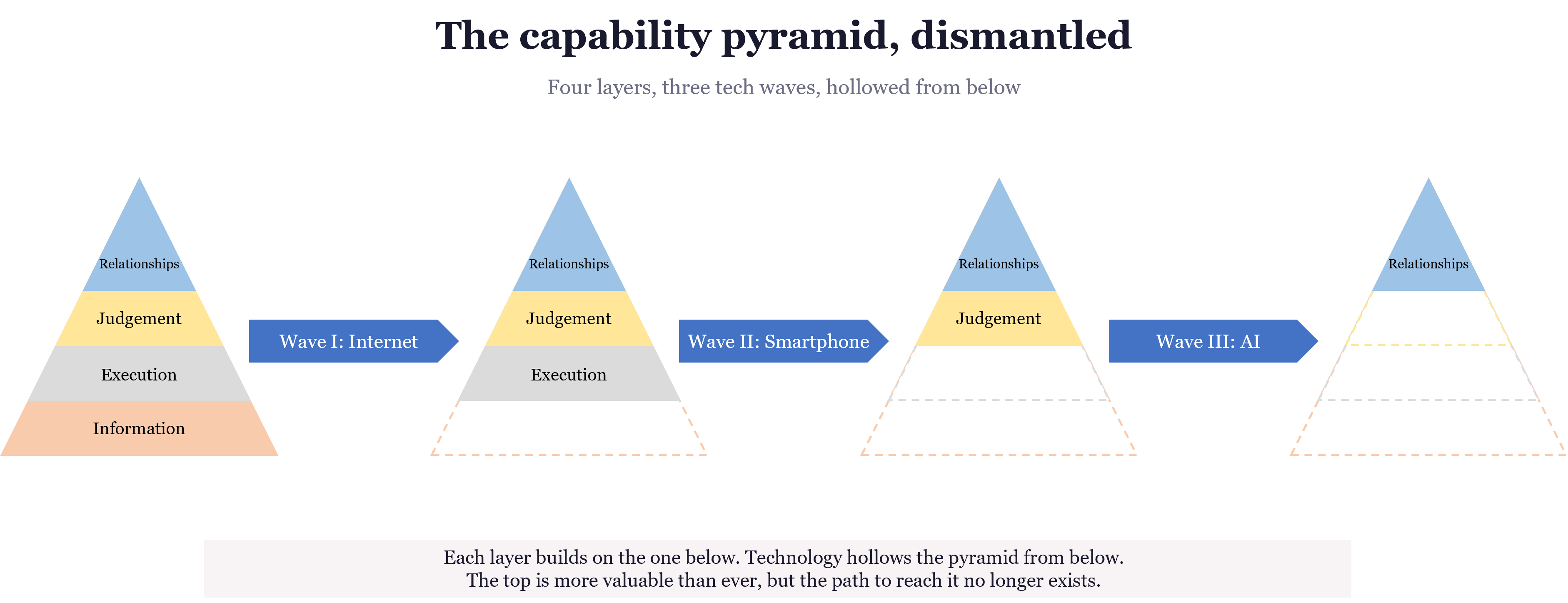
The base: information.
Knowing what’s in the city, how to get there, when things open, which neighborhoods are worth exploring. When guests arrive in an unfamiliar city, this is the first thing they need. This was the concierge’s most fundamental daily function.
Layer two: basic execution.
The guest tells you what they want, you make it happen. “Book me Le Cinq tonight.” “Get me two tickets to Rigoletto at the Royal Opera House tomorrow.” “Arrange a car to the airport.” The guest has already made the decision. You carry it out.
Layer three: personalized judgment and holistic planning.
The guest hasn’t figured out what they want. You figure it out for them. “I have two free days. Put together an itinerary for me.” Now you’re weighing the guest’s fitness level, interests, and pace preferences. You’re deciding between a national park outside the city or an art museum downtown. You’re choosing which Michelin restaurant fits the evening and what style of bar works afterward. You’re factoring in weather, distances, crowd levels, and timing. You produce a plan the guest couldn’t have come up with on their own, but that feels “just right” when they experience it. This used to be the concierge’s core professional moat.
The top: relationship capital and “making the impossible happen.”
Getting a guest into a restaurant no one can get into. Securing tickets to a show that sold out months ago. Arranging a private experience that doesn’t exist on any website. This isn’t about information, execution, or judgment. It’s about a decade of accumulated favors, trust, and reputation.
This is a classic capability development path. Without doing large volumes of basic execution, there’s no opportunity to develop judgment. Without years of sending guests to restaurants and buying tickets, building up credibility and goodwill along the way, there’s no way to weave that golden network. The pyramid held together because the base supported everything above it.
This used to be a matter of course.
Then technology started pulling out the layers from below.
Three waves, each removing one layer
The first wave was the internet (roughly 1995-2007).
Before this, guests arriving in an unfamiliar city had almost no other source of information. The concierge was their only efficient interface with the city. After the internet, guests could research attractions, restaurant rankings, and transportation routes before they even packed. By the time they reached the hotel, most basic questions no longer needed asking. The base layer was gone: the concierge’s information monopoly was broken.
The second wave was the smartphone and apps (2007-2015).
Google Maps replaced hand-drawn directions on paper maps. OpenTable replaced phone calls to book restaurants. StubHub replaced ticket brokers. Uber replaced arranging cars for guests. Hotels themselves launched digital platforms, bundling dining, transportation, and ticketing into mobile apps. Guests could not only find information on their own but act on it themselves. As one industry insider put it bluntly: “I’ve got a portable concierge in my pocket. And I don’t have to tip.” The second layer was gone: basic execution no longer required the concierge.
The third wave is AI (2015-present).
This wave attacks from both sides. From the outside, guests open ChatGPT and type: “I have two free days in New York, I like nature and good food, plan something for me.” The output is already quite good. From the inside, hotels have been deploying AI chatbots to standardize service workflows, turning personalized recommendations and itinerary planning into replicable products. AI chatbots now handle 80% of routine guest inquiries at many properties. One hotel industry report showed a 78% drop in concierge call volume during peak periods at a resort. The third layer is being stripped away: personalized judgment and holistic planning are being squeezed from both the organizational inside and the guest-facing outside simultaneously.
After three waves (the third still underway), only the top of the pyramid remains: relationship capital, the ability to get things done that no one else can. This layer, AI cannot yet reach.
A castle in the air
This isn’t a phenomenon unique to the hotel industry. Across nearly every service industry, both employers and individuals are racing to adopt AI. Customer service chatbots are standard. Standardized workflows are being automated at every level. But the work that sits at the very top of any profession, the work that depends on human relationships, contextual judgment, and the ability to navigate ambiguity through trust, remains extremely difficult to replicate at scale. A chatbot can answer a guest’s question, but it can’t make a phone call that trades on a personal favor. An LLM can draft a consulting framework, but it can’t originate one that reshapes how a client thinks about their business. The more thoroughly the lower layers get automated, the more visibly irreplaceable the top becomes.
But top concierges are more valuable not simply because they’re scarcer. It’s because the pipeline that produced them is closing. Rising prices may not fully reflect improving capability. More likely, they reflect the market’s expectation that future supply is about to collapse.
The relationship networks those top concierges hold were built over ten to fifteen years of working through the three layers below. Every restaurant reservation was a deposit into a relationship. Every ticket purchased was another connection formed. Every itinerary planned was another layer of judgment deposited. The “impossible tasks” they accomplish today are the compound interest on 3,650 “ordinary days” before them.
Now a new hire joins the concierge desk, and the situation is stark. The information work at the base has been absorbed by the internet. The execution work at layer two has been absorbed by smartphone apps. The judgment and planning work at layer three is being squeezed by AI from both ends. There is almost nothing left that would allow them to organically accumulate the relationships and judgment needed to reach the top.
And it’s not just the work itself that disappeared. The leverage disappeared with it. A concierge used to be valuable to a restaurant because they represented a steady stream of guests from the hotel. That stream now flows through OpenTable and Google. A new hire sitting quietly at the concierge desk has far less to offer partners than their predecessor did fifteen years ago. Not because they’re less capable or less motivated, but because the structural currency they could trade on has been steadily absorbed by technology.
This is what a castle in the air looks like: the top still stands, but the structure beneath it has been hollowed out, one layer at a time.
The path is broken. But who benefits?
There’s a layer of incentive structure here that most people haven’t noticed.
AI is leverage for senior concierges. They already have judgment, a relationship network, and trust deposits at every high-end restaurant and venue in the city. Plug in AI, and they can respond to guests faster, serve more requests simultaneously, cover a wider range. Their output per unit of time is being amplified.
AI is a crutch for junior concierges. It can help them generate a decent-looking itinerary faster, but it can’t earn them the trust of a restaurant’s executive chef, can’t build them a decade of personal connections, can’t teach them what it means in a real situation when “this guest won’t like that kind of arrangement.”
So the result isn’t everyone getting stronger together. It’s this: the veterans use AI to thicken their moat, while the newcomers lose the very work that used to build their capabilities.
From an individual perspective, senior employees embracing AI is an entirely rational decision. It means widening their advantage over successors at the same time that the path for successors is narrowing. But what does this mean for the organization?
Hotels think they own this capability. They’re just renting it.
For many luxury hotels, the concierge has never been just an add-on service. It’s a core part of the hotel’s competitive advantage. Guests are willing to pay more for a hotel not just because the rooms are bigger, the location is better, or the decor is nicer, but because they believe: at this hotel, things that can’t be done elsewhere can be done here.
The problem is that this capability often doesn’t truly belong to the hotel. It belongs to a specific senior concierge as an individual. Who he knows, who takes his calls, who holds a table for him, who treats him as someone worth doing favors for. None of this lives in the brand manual, in standard operating procedures, or in any app. The hotel sells this capability as its own differentiator, but if it hasn’t been replicated, passed down, or institutionalized, the hotel doesn’t actually own it. It’s merely renting one person’s relationship network, judgment, and reputation.
The moment that person retires or leaves, what disappears isn’t just an employee. It’s a piece of the hotel’s competitive advantage that genuinely existed.
This is the problem AI creates that runs deeper than “the career path is broken.” AI lets senior employees amplify their personal leverage through technology while simultaneously dismantling the task structures that new hires need to develop capability. The result isn’t a stronger organization. It’s an organization whose core capabilities are increasingly bound to a handful of individuals. Skills and capabilities should be preserved within the organization, not tied to specific people. But if the way AI gets used only makes veterans stronger and newcomers hollower, the organization is effectively re-privatizing capabilities that should be organizational assets, handing them to a few incumbents.
For the senior employees, this is a smart deal. For the organization, it’s dangerous.
This isn’t just a hotel story
If you swap “concierge” for “consultant, lawyer, analyst, engineer,” and swap “booking restaurants for guests” for “writing reports, doing research, building slide decks,” you get an almost identical structure.
These professions share the same capability formation mechanism: newcomers start with high-frequency, low-risk, repeatable tasks, develop judgment through repetition, then gradually take on high-risk, relationship-intensive work, eventually forming the scarce capabilities that only a few possess. AI is cutting exactly the first two stages of that pipeline. The result isn’t “we don’t need experts anymore.” It’s “the mechanism that produces experts is broken.”
The concierge profession is worth paying attention to not because it matters in itself, but because it has already completed this cycle in full. The base has been stripped away layer by layer, the top has become more valuable and more unreachable at the same time, and capability has flowed from the organization to the individual. What consulting, law, finance, and engineering are experiencing with GenAI right now is the same road. They’re just in the first half.
A few days ago, I wrote about how GenAI is cutting the people it can’t replace: organizations are eliminating the roles that carry the talent development function while retaining the roles whose work is actually being compressed by AI. The concierge profession is what that road looks like at the finish line.
Top players still have a seat at the table. They may even eat better than before. But “how to become a top player” is a question this profession can no longer answer.
And an industry that can only sustain its peak but cannot produce the next generation to reach it isn’t becoming more elite. It’s becoming more fragile. Because today’s top players all walked up from yesterday’s bottom, one step at a time. Cut off the path from the bottom, and the top stops renewing itself.
This is the deepest impact that the technological revolution, led by GenAI, has on a profession. Not replacing it, but stripping it of the ability to reproduce and elevate itself.