

On March 7, I watched Roberto Bolle perform Caravaggio at the Hong Kong Cultural Center — the Asian premiere.
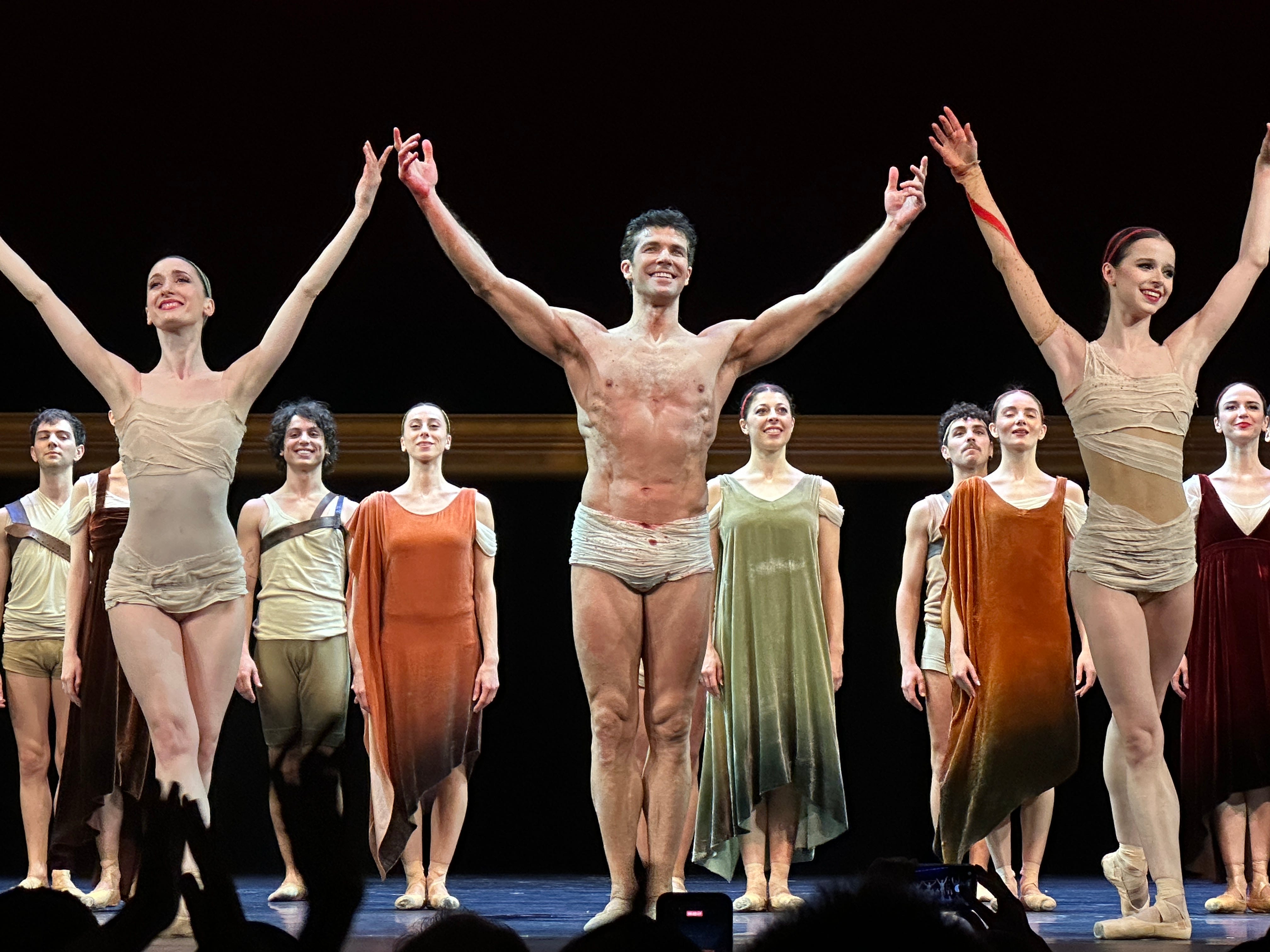
He is 50 years old. Most ballet dancers’ careers wind down by around forty. Bolle is still center stage. His physique remains immaculate, and his control so precise that dancers half his age can seem tentative beside him.
Walking out of the theater, I kept circling a single question: how many people once had Bolle’s talent — even seriously considered ballet as a career — but ultimately chose a different path?
The answer: the vast majority.
Not because they weren’t good enough. Because they did the math.
Ballet is an industry that almost exclusively keeps room for the very top. The number of dancers worldwide who can live comfortably on ballet alone is surprisingly small. Most who dedicate a decade of brutal training still earn unremarkable incomes. And these same people — with exceptional physiques, fierce discipline, and strong learning ability — could quite possibly do far better in the corporate world.
And that leads to a survival strategy that is now starting to break down.
The Misplaced Spike: A Smart Career Strategy in Noisy Systems
In many competitive environments, a single A+ trait beats being B+ at everything — as long as the evaluation system is noisy enough.
This is why someone who would only rank B+ in the modeling world can do extremely well in a corporate setting.
The modeling track has a narrow evaluation frame: face, physique, camera presence. Everyone around you is A+. Your A+ appearance offers no edge. But the corporate track is entirely different — the evaluation dimensions are many and the noise is high: analytical ability, communication, appearance, political instinct, stakeholder management. You might be a B in every dimension except one: appearance, where you are A+. Among colleagues who are uniformly B+ with no standout trait, that single spike is enough to set you apart. Your A+ appearance becomes the strongest signal in the room.
Your boss may not be able to articulate why you seem better than your peers. They just feel that you are “different.”
This is not deception. It is not gaming the system. It is placing your spike in the arena where it will be most recognized. Anyone who has spent time in the corporate world has seen this in action — you may even be this person yourself. It is, at its core, a supremely rational act of resource allocation: if my absolute advantage isn’t competitive in certain arenas, why not carry it into a different one and push for a breakthrough? After all, it might be the trump card there.
This strategy used to work extremely well. Because knowledge work was evaluated through systems that were complex, noisy, and often opaque — fluent delivery, polished slides, smooth stakeholder management — few bosses could clearly tell whose analysis was actually better. The person who looked the most professional often won.
Until AI arrived.
AI Didn’t Change the Talent. It Changed the Signal.
Picture a market intelligence team of three. Many managers would staff it like this: one analyst with outstanding analytical depth, one efficient executor handling the groundwork, and a third who is “decent” across the board but more “presentable” — well-rounded, good with clients and senior stakeholders.
AI is making this three-person structure less stable. The workflow that once required three people is increasingly compressible to one or two — and the person more likely to remain must be capable of working independently. That means genuinely understanding how to make judgment calls.
Not because the boss suddenly became more discerning. Because the structure of the role itself has changed. When one person must collaborate with AI across the full chain — prompting, reviewing output, making judgment calls — the person who is “decent at everything but not outstanding in core judgment” increasingly struggles to justify their place.
And here’s the compounding effect: AI is making a growing share of output easier to quantify and compare. Previously, your report and your colleague’s report sat side by side, and the boss judged them largely by impression. Noise was high. Now AI can generate a logically coherent, well-formatted industry analysis in minutes. Once your report is placed directly next to it, you may not come out ahead. Those who can outperform AI will likely do so not through prettier formatting, but through stronger judgment, better frameworks, and sharper problem definition. Meanwhile, those who have been coasting find it harder and harder to hide.
Once the noise in the arena is compressed, the “misplaced spike” strategy starts to break down.
Your A+ appearance, in an environment where AI has already set a clean, legible baseline, is no longer the strongest signal. The real signal is now: can you produce judgment that AI cannot?
Leaving STEM, Rushing into the Creative Fields — Then What?
Two claims have gained significant traction recently.
Daniela Amodei, co-founder and President of Anthropic, has said that studying the humanities will be “more important than ever.” Her core point: as AI models grow increasingly capable at technical tasks, the ability to understand humans themselves — history, motivation, what makes us human — becomes scarcer.
Investor Peter Thiel has argued that AI will hit “math people” harder than “word people.” His point is not that the humanities will win. It is that math’s monopoly as a single screening mechanism is being eroded by AI — much as chess stopped being the ultimate proxy for intelligence after Deep Blue defeated Kasparov in 1997.
An oversimplified narrative has taken hold: STEM is finished. The creative and interpretive fields are the future.
Early signals are appearing: in 2025, a growing number of US computing programs reported weakening undergraduate enrollment, particularly in traditional computer science, software engineering, and information systems tracks. Many are starting to believe: if AI can already write code, what is the point of learning to program? Better to study screenwriting, art, philosophy.
I believe there is a dangerous misreading buried in this logic.
Amodei and Thiel are both right — but their words are being over-interpreted. Amodei is emphasizing that critical thinking and deep understanding of people will be scarcer in the AI era, not that a literature degree is a ticket to safety. Thiel is saying that math as a gatekeeping mechanism is losing its authority, not that the creative fields will outperform STEM.
What will actually happen is far more complex than a “creative renaissance.”
Talent Flows Back — Not Out of Passion, but Out of Pressure
The first wave of people squeezed out of STEM and analytical roles will try to flood into AI-adjacent tracks — AI products, machine learning, automation. But these tracks are themselves likely to become crowded quickly. Models can already handle a growing share of foundational coding work. The capacity of this path is far smaller than people imagine.
Some will pivot to sales, operations, entrepreneurship, hardware. But there is another group — people who once had significant original creative talent but abandoned high-originality fields because the risk-reward ratio was too unfavorable — who will begin to reconsider.
In the past, a person with writing talent who went into consulting could earn five times what a freelance writer makes. A person with artistic talent who went into finance had far greater income stability than an independent artist. The math was clear. They rationally chose the safer career path.
But as AI compresses the mid-tier returns of these safer paths — as entry-level analyst hiring slows, as much of the output once produced by junior and mid-level consultants can now be rapidly generated by AI as a competent first draft — the certainty premium of staying on these paths is no longer high enough. Some begin to ask themselves where their real comparative advantage actually lies.
This is not “returning to one’s passion.” It is being pushed back out of the lane they had chosen.
High-Originality Fields Were Never a Safe Haven — They Were Always Closer to Ballet
Think back to Bolle.
The brutality of ballet is that it almost never sustains a stable middle tier. No “decent” ballet dancer makes a comfortable living from ballet. You are either at the top, or you leave.
Knowledge work used to be different. Corporations had a vast middle tier — not the strongest, not the weakest, sustained by well-rounded competence and misplaced spikes. This is precisely why people with ballet talent, artistic talent, or writing talent rationally chose corporate careers: corporations reserved space for the middle.
But AI is turning more and more knowledge fields into something that looks like ballet.
As high-cognition talent gets pushed out of safer career paths and flows back into high-originality fields, the competitive intensity of those fields will rise sharply. In the past, these fields could sustain a significant volume of mediocre production for extended periods — not necessarily because the barriers were low, but more because the strongest players had long been siphoned off by finance, consulting, law, and technology.
This helps explain what we see today: films with loose narrative structures and character motivations that don’t hold up to scrutiny — storytelling whose dramatic coherence may not match the craft of a traditional opera. Segments of contemporary art where neither formal rigor nor genuinely persuasive conceptual breakthroughs are on display, yet the work still circulates within relatively closed evaluation systems.
This doesn’t necessarily mean these fields are inherently more “diverse” or “inclusive.” It more likely means one thing: when top-tier competitors are absent for long enough, the baseline level of the field will drop.
Now this dynamic is beginning to reverse. Those who once traded their original talent for income and certainty are finding the safe path narrowing. Once they flow back, they will raise not only the ceiling of these fields but also the floor.
People who survived on “good enough” will discover, for the first time, that they had been operating in an arena where competition was never as fierce as they assumed.
The middle tier of high-originality fields is likely to follow the same trajectory now visible across many STEM careers: loosening first, then contracting.
AI Won’t Reward Your Major. It Rewards Irreplaceability.
So the conclusion is not “study the creative fields and you’ll be safe.” The conclusion is:
AI is turning every field into ballet.
Across every track, the middle is loosening. Whether you chose STEM or the arts, “good enough” is failing as a survival strategy. What is actually being rewarded is neither a disciplinary label nor a misplaced spike, but irreplaceability — the ability to ask better questions, render harder-to-replace judgments, and build a position that others cannot easily replicate.
Roberto Bolle is still center stage at 50 — not because ballet is a “good track,” but because he still constitutes irreplaceability within it.
Real security in the age of AI does not come from picking the right major or profession. It comes from becoming hard to route around in the field where your real talent lies.
This is not a comfortable conclusion. But it is what Roberto Bolle began proving early in life — and has spent half a lifetime demonstrating since.