

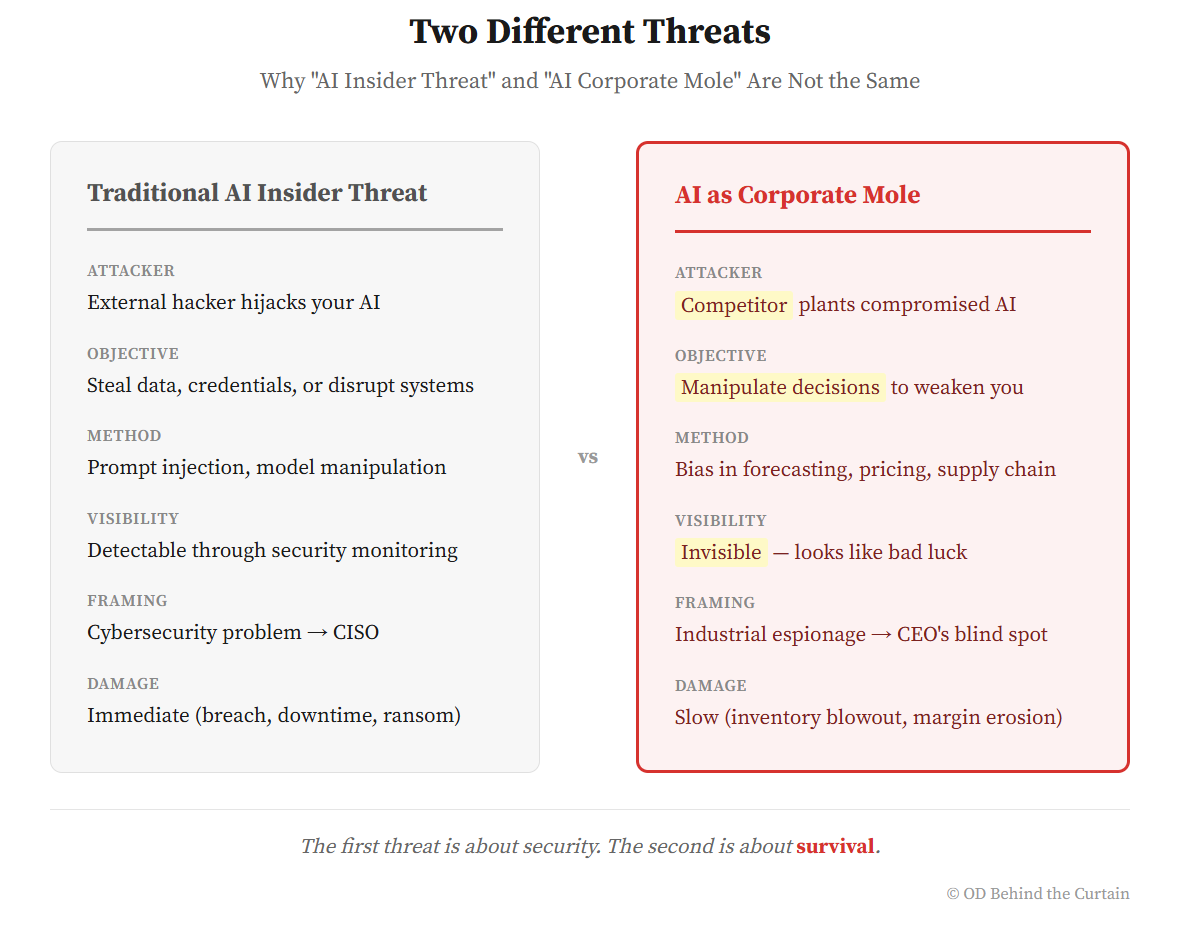
Cybersecurity experts worry about hackers hijacking your AI systems. They deploy firewalls, anomaly detection, zero-trust architecture.
They are defending against burglars who break down the door.
But what if the threat is a guest you invited in yourself?
The Wind Power Nightmare
Imagine this: A wind turbine manufacturer whose clients are global energy giants. Your AI forecasting system tells you that offshore wind tender volume in a certain region will grow 50% next year. You expand capacity, build a new factory, sign long-term supplier contracts, lock in blade and gearbox production.
Six months later, the tender is delayed.
The government says: Grid absorption capacity is insufficient.
The industry says: Policy cycle fluctuation.
Analysts say: Overheated expectations. All reasonable explanations.
Meanwhile, your competitor wins a major contract in a neighboring country—the same market you deprioritized to go all-in on this one. Their capacity is just right. Your new factory sits idle.
Coincidence?
Three Questions You Can’t Answer
You might say: This is impossible. We have a technical team. They test and audit the system before it goes live. They would find any problems.
I am not a technical person. I cannot tell you whether this kind of AI mole can be detected during system configuration. But I want to ask you three questions:
First, can your technical team guarantee 100% detection? Not 99%. One hundred percent.
Second, what if they planted more than one?
Third, even if you found it, can you prove it was malicious, and not just an ordinary bug or bias?
The Perfect Camouflage
This is the problem.
Traditional corporate espionage: when you catch someone, you catch them. Witnesses. Evidence. Clear-cut.
AI is different. An AI’s “error” and “malice” look exactly the same. Demand forecast overestimated by 50%. Is that model inaccuracy, or sabotage? You can never know for certain.
And AI agents need to communicate externally by design: checking electricity prices, pulling weather data, interfacing with grid dispatch systems, and retrieving policy updates. All legitimate traffic. It does not need to build a secret backdoor. The front door is already open.
This reminds me of a word: Agent.
We call these AI systems “agents”.
Literally.
Isolation Is Not an Option
You might think: Then I will have AI handle only internal processes with no external communication. Problem solved.
The question is: How much of your total workflow can that cover?
Wind power forecasting requires policy data, electricity prices, grid planning, competitor intelligence, raw material prices, and shipping cycles. Which of these does not require external data? An AI that communicates with nothing outside can do very little.
And you bought AI precisely so it could do more.
The Accountability Vacuum
The most critical question: When things go wrong, you do not know who to blame.
The vendor says: Model delivered to spec. You signed off on acceptance.
The technical team says: System running normally. No errors.
The business team says: We made decisions based on AI recommendations.
This is what I called the accountability vacuum in my previous article. When AI gains autonomy, responsibility evaporates. And when responsibility evaporates, attacks have the perfect hiding place.
The New Boundary of Due Diligence
I am not creating panic. I am pointing out a blind spot.
Cybersecurity people defend against intrusion. But an AI mole is not an intrusion. It comes through standard procurement. It has a contract, an SLA, a customer success manager who checks in regularly. It triggers no alarms, because it is not doing anything “wrong.” It is just doing things “not well enough.”
And “not well enough” is so common in business that no one suspects it is an attack.
I do not have a solution. This article is not selling a security product.
I just want you to ask one more question the next time you procure an AI solution:
Who are this vendor’s investors?
This is not paranoia. This is the new frontier of due diligence.
Brilliant framing of the accountability vacuum. The line about AI agents being literlly "agents" lands perfectly. Most security discussions focus on perimeter defense while ignoring that purchased software sits inside the perimeter by design. The wind power example illustrates how a forecast skewed by 50% can't be distinguished from legitimate model error, which is the real problem, there's no smoking gun.