

It sounds counterintuitive. But hear me out.
Why Do Companies Hire Consultants for Downsizing?
Downsizing is never easy, especially when it involves restructuring at the operational level. It is bitter medicine. But when companies face this decision, they often seek external consultants.
The motivation usually comes down to two things:
First, to force “Shock Therapy.”
Just as many cities bid for the Olympics as an excuse to push through infrastructure upgrades, companies want to kill two birds with one stone. Managers know certain inefficient processes have been broken for years, but they are impossible to fix in peacetime. Downsizing provides the perfect “crisis window” to make previously unthinkable changes suddenly acceptable. This requires an external player to drive the process redesign.
Second, to buy expensive “Emotional Buffering.”
Even when the board’s decision is firm, managers are still human. Nobody likes facing accusations, especially the emotional kind from affected employees. Bringing in an external consultant as the “bad guy” or “buffer layer” protects management’s image during the transition and reduces direct confrontation.
But consultants are not cheap. Since every dollar must count, a critical question emerges:
At what scale of downsizing does it actually make sense to bring in an operational consultant?
Based on my consulting experience, I’ve found this follows an inverted U-curve.
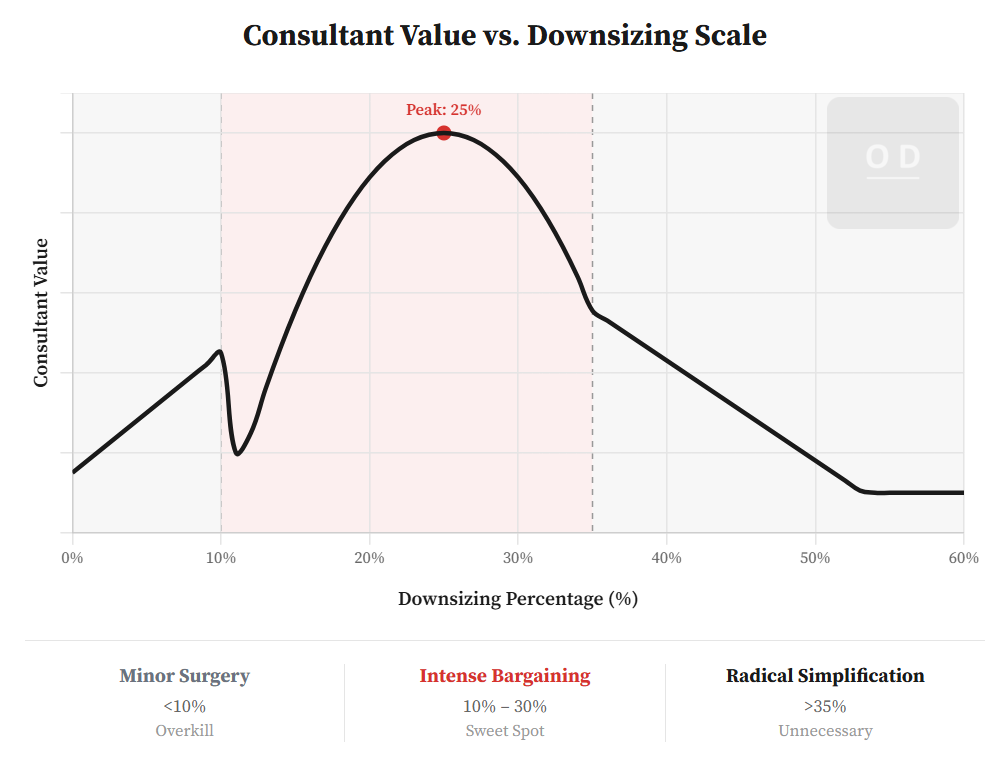
(Author’s Note: I need to be honest here. The “35%” figure is based on experience, not a formula. I know the HR industry loves its “hard metrics”—optimal span of control is 5-10, reporting layers shouldn’t exceed 7, etc. While these numbers claim to have rigorous mathematical backing, they are often flimsy, failing to account for the speed of technological change like AI. They exist mainly to give decision-makers a “scientific basis” for cover. I choose not to play that game. My 35% rule comes from 17 years of witnessing firsthand how organizations react to trauma. I don’t have a formula, but I have enough cases. If you need mathematical proof to believe me, this article is probably not for you.)
The Minor Surgery Zone (<10%): Internal Absorption
When downsizing is less than 10%, you typically don’t need external help.
The change is too small. The core organizational structure remains intact. Leaders at each level have both the capability and the bandwidth to redesign processes themselves. Bringing in a consultant at this stage is overkill.
The Intense Bargaining Zone (10% to 30%): The Consultant’s Sweet Spot
This is where external consultants are most needed. Around 25% is usually the peak of both pain and complexity.
In this range, the organization has not entered “survival mode.” Most core functions are preserved. But this is precisely what makes it dangerous. People still have energy to play politics.
Every department thinks they can still negotiate.
“Have your cake and eat it too” process designs keep emerging.
Headcount is down but workload isn’t, leading to endless turf wars over task distribution.
This is when you need an external consultant to be the “villain,” the “referee,” to force through the blockages caused by competing interests.
I once worked with a major beverage company going through a 25% reduction. Every meeting was a battlefield. Department heads would challenge my sizing model, not because the math was wrong, but because accepting the numbers meant accepting that their peers or even their bosses had made poor decisions. The sizing model became a proxy war. Nobody wanted to own the cuts, so everyone attacked the methodology instead. We spent weeks in loops of “Can we revisit the assumptions?” and “What if we keep just this one role?” The work that should have taken two months stretched to five. This is the 25% zone: enough pain to matter, not enough to force simplicity.
The Radical Simplification Zone (>35%): Complexity Collapses
This is the most counterintuitive conclusion: When downsizing exceeds 35%, you no longer need an operational consultant.
When an organization suddenly loses more than a third of its people, it’s no longer “slimming down.” It is “amputation.” This extreme pain produces an unexpected byproduct: Minimalism.
Communication costs collapse. In modern workplaces, enormous energy is spent on communication just to “align.” When headcount drops dramatically, the web of communication shrinks. The survivors have no choice but to collaborate in the most direct way possible.
Fewer people, higher output. When ineffective and inefficient processes are forced out because there is simply no one to do them, what remains is core business. Sometimes output efficiency actually increases.
On the ruins of a 35%+ downsizing, process design becomes remarkably simple: When there is no choice, there is no need to validate.
I saw this firsthand at a technology company that cut 50% of its workforce in one wave. My job was supposed to be complex—redesigning workflows, mapping responsibilities, managing resistance. Instead, it was the easiest engagement I ever had. There was no negotiation. No turf wars. No endless debates about “what if we kept just one more person.” When you cut half the company, you don’t split one person’s job among three survivors. You hand everything to the one person left standing. The urgency was universal. Handovers that would normally take weeks happened in days. People weren’t fighting over territory. They were focused on not drowning. The complexity I was hired to manage had already collapsed under its own weight.
Like battlefield first aid that only requires a tourniquet, you don’t need experts for complex process analysis. There is no cross-departmental finger-pointing. Survival is the only logic.
A Final Note
I need to make a critical distinction: I am talking about operational consultants.
When downsizing exceeds 35%, the compliance risks and brand crises are massive. You absolutely need legal counsel and PR advisors to protect the ship.
But on the operational side, managers need to understand a harsh truth:
When the cut goes deep enough, complex problems simplify themselves.
At that survival threshold, the best consultant is not an outside expert.
It is the instinct to live.