

A new breed of 24-hour, low-staff, self-service instant noodle shops has been popping up across Shanghai. The concept is simple: a wall of instant noodles from around the world, a row of open refrigerators stocked with loose toppings (cheese, eggs, bean sprouts, kimchi), and a few cooking machines. Customers pick their noodles and toppings, scan to pay, cook everything themselves, and clean up when they’re done. Some of these shops operate with virtually no staff. Others keep a skeleton crew for basic guidance. But they all share one thing in common: the consumer has been pushed forward into a food preparation process that should be controlled by the business.
The concept reportedly came from South Korea. Koreans consume nearly 80 servings of instant noodles per person per year, and 24-hour unmanned noodle shops are a familiar sight on the streets of Seoul. The format landed in Shanghai in late 2024, sparking a city-wide wave of curiosity. Social media was flooded with tags like “K-drama late-night canteen” and “Seoul street food experience.”
I visited one of these shops in Shanghai recently, specifically to inspect the food preparation area.
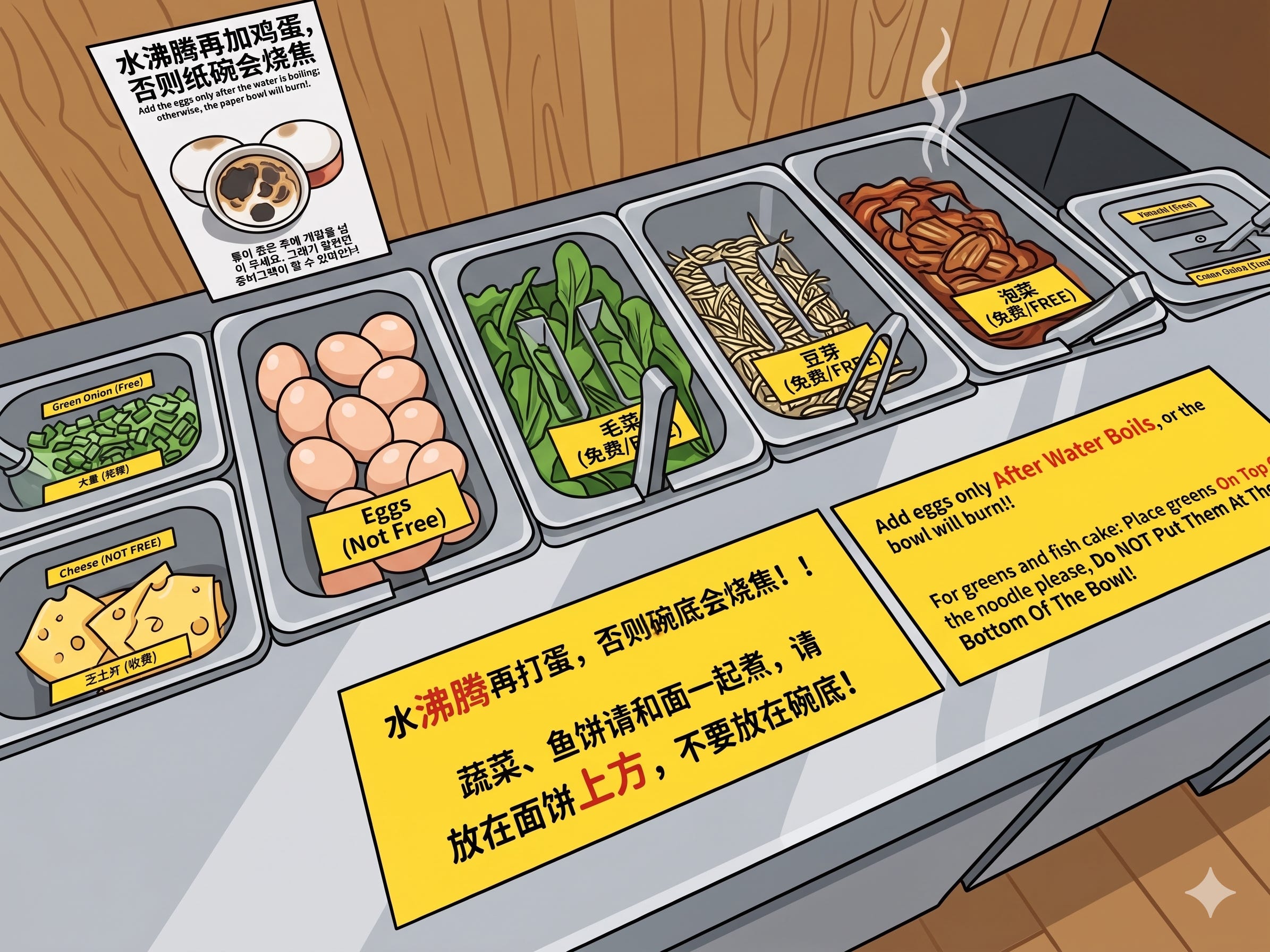
The toppings sat in the refrigerator, dish by dish, each with a lid that any customer could lift at any time. Shared tongs were stuck in beside them. Anyone could grab them. The shop had three security cameras, but only one was angled toward the food area. I estimated that if two or three people stood in front of the refrigerator at the same time, they would create a perfect physical obstruction. The camera would capture essentially nothing of what was happening at the food station.
This is not a management failure at one particular shop. This is a structural defect baked into the business model itself.
One Bowl of Noodles, Four Suspects
Suppose you eat a bowl of noodles loaded with toppings at one of these shops, and you get food poisoning afterward.
Was the cheese not fresh? Did you not cook it long enough? Did the previous customer contaminate the shared tongs without cleaning them? Or were the unsealed disposable bowls and chopsticks already compromised?
Four possible causes, each pointing to a different party in the process: the supplier, you, another customer, or the equipment operator. Once something goes wrong, there is virtually no way to determine which link in the chain failed.
In a traditional staffed restaurant, this ambiguity does not exist. The entire process, from raw ingredients to kitchen to your plate, falls within the restaurant’s control. If something goes wrong, the restaurant is the accountable party, full stop. Staffed restaurants certainly have food safety problems too. Filthy kitchens are hardly rare. But the critical difference is this: when something goes wrong in a staffed system, it can be traced, accountability can be assigned, and the system can improve.
Whether an accountability chain exists and is traceable is a completely different question from whether the people on that chain are doing their jobs properly. The first is a system architecture problem. The second is a management problem. The fatal flaw of the unmanned noodle shop lies in the first: its accountability chain is physically severed at the point of service.
Food delivery at least has tamper-evident seals. An intact seal means the problem originated at the restaurant. A broken seal means something happened during delivery. It is imperfect, but it provides a physical demarcation point that can partition accountability. The unmanned noodle shop has no such demarcation. None at all. From refrigerator to tongs to cooking machine to your mouth, the entire process is a continuous, unmonitored, multi-user open flow. Because no one is watching the stage where real-time judgment and correction matter most, even after-the-fact investigation is nearly impossible.
I have written previously about what I call the “Sun’s Decision Authority Matrix,” one of whose core arguments is this: when an AI-driven autonomous chain is running, accountability dilutes along the chain until every party can say “it’s not my problem.” The accountability structure of the unmanned noodle shop is perfectly isomorphic. When something goes wrong, every party can point the finger at someone else. On-site, no single party’s accountability covers the complete chain from ingredient to ingestion.
And this is before we even consider the low-probability but catastrophic risk of deliberate tampering. What should truly alarm us is not that such incidents happen every day, but that the system was designed from the outset without any front-end intervention mechanism.
The Bar, the Delivery Rider, and the Vending Machine
Consider this scenario: you order a drink at a bar, step away to use the restroom, and come back. Do you drink it?
Anyone with basic safety awareness would not. At a bar, “never leave your drink unattended” is practically common sense. You have no way of knowing what might have been added during the minutes you were gone.
Now think about the topping station at an unmanned noodle shop. The loose cheese, vegetables, and eggs sit exposed from opening to closing, and many of these shops never close at all. Any customer, or even a non-paying passerby, could sneeze over the toppings, handle the shared tongs with unwashed hands, or do anything else while no one is watching.
Why are we so vigilant at bars but so trusting at noodle shops? On what basis do we assume that strangers in an unmanned noodle shop are inherently more trustworthy than strangers at a bar?
Then recall the recent controversy over delivery riders bringing food orders into restrooms. A rider, desperate to use the bathroom, carried the sealed food package inside with him, and customers found it revolting. But if we compare the two situations calmly, the food safety risk in that scenario is actually far lower than in an unmanned noodle shop. The food was sealed, stayed within the rider’s line of sight, and accountability could be clearly traced to a person. Even if the rider left the package outside the restroom door to spare the customer’s feelings, creating a brief gap in the accountability chain, the exposure was short, the packaging intact, and the customer could at least take some comfort in that. At the unmanned noodle shop, the uncovered food is fully and continuously exposed to anyone’s reach, for hours on end.
Finally, the vending machine. I know someone will argue: vending machines are unmanned too. Why are they fine?
Because a vending machine’s products are factory-sealed and physically isolated from the point of manufacture to the point of purchase. Before the product drops into the pickup slot, no external party can physically interfere with its quality. When something goes wrong, the accountability chain is crystal clear.
Line up these scenarios on a spectrum: vending machine (fully sealed, no human judgment required) → food delivery (tamper-evident seals, a rider watching, but with brief blind spots) → bar (the customer knows to stay alert) → unmanned noodle shop.
The noodle shop sits at the worst end of this spectrum, worse even than the bar. Because at a bar, at least you know to stay vigilant. The noodle shop wraps itself in the warm aesthetic of “K-drama vibes” and “cozy late-night canteen,” lulling you into dropping your guard entirely.
Someone might push back: if a staff member were standing in the shop, would they really be watching the food station? Maybe they would just be scrolling their phone. But that is beside the point. A person on-site, even one who is not paying close attention, provides three things that no unmanned system can: visual deterrence against customer misconduct, real-time detection of anomalies, and the ability to intervene within seconds of spotting a problem.
They do not need to watch like a hawk. They just need to be there. A security camera cannot deliver any of these three.
The Price of Convenience
I will not deny it: unmanned noodle shops tap into a genuinely distinctive urban need. A full wall of novelty choices, the absolute “introvert-friendly” absence of staff watching you, and the light participatory thrill of adding your own toppings and cooking your own bowl. This specific combination of emotional payoffs is something a FamilyMart, a Lawson, or a late-night street-side fried rice stall simply cannot offer.
It addresses a real niche. It is a real business.
But as an organization design observer, I need to look through the surface of this transaction. You think you are spending twenty-something yuan for late-night convenience and a taste of K-drama atmosphere. But what the system has quietly priced in is this: you are simultaneously waiving the establishment’s obligation to maintain on-site quality control.
That is the most hidden trade-off in this entire business model. “On-site accountability” has been swapped for “Absolute introvert-friendliness.”
In exchange for the convenience of not being bothered by staff, you have transferred food safety accountability from a system where someone is physically present and watching, to a blind zone with no physical safeguards where the only recourse is after-the-fact accountability. And as we have already seen, in an open environment where evidence is virtually impossible to preserve, after-the-fact accountability is a dead end in practice.
This is not a fair trade. And this hidden cost: does the consumer truly understand it at the moment they push open the door?
The Bigger Picture
The unmanned noodle shop is not an isolated phenomenon. Just a few years ago, the dominant narrative in global business innovation was the “sharing economy.” Assets are scarce, labor is abundant, so put idle assets to work serving more people.
Now the wind has shifted abruptly. Unmanned noodle shops, unmanned game rooms, unmanned dessert bars are springing up across city streets. The underlying logic has flipped to: “People are too expensive. Remove them.” And we have already seen what happens to the accountability chain when you rip people out of it.
I am not against automation itself. Autonomous driving has genuine safety and strategic value. Unmanned ports address high-risk, high-intensity, round-the-clock operational demands. Smart agriculture tackles labor shortages and food security. These forms of automation replace work that humans are unwilling to do, physically unable to do, or unable to do well enough. But the unmanned noodle shop replaces a shop attendant who earns a few thousand yuan a month, a role plenty of people are willing to fill. This kind of consumer-sector “save on labor” play should not be conflating itself with the hard-core innovations that genuinely matter for national infrastructure and public welfare.
(I will write a separate piece on the capital narrative patterns behind the unmanned economy.)
Back to That Bowl of Noodles
I am not against technological progress, nor against business model innovation. But when the core logic of a so-called “innovation” is simply removing a human from a process, and after removing them, the on-site judgment and real-time correction they provided is not replaced by any equivalent systemic safeguard, that is not innovation. That is operating without a safety net.
A vending machine can run unmanned because its process never required human judgment in the first place. Products stay physically sealed from start to finish. That is clean automation.
The process inside an unmanned noodle shop is full of moments that demand judgment: Is the ingredient fresh? Is there cross-contamination? Has the food been cooked long enough? Is anything abnormal happening on-site? But these judgment calls have not been replaced by better mechanisms. They have simply been eliminated. This is pseudo-automation that offloads safety costs onto consumers and statistical probability.
A healthy business system, staffed or unstaffed, should be able to answer one question clearly at every critical node: “If something goes wrong here, who is on-site to catch it?”
The unmanned noodle shop cannot answer that question. And this unanswerable gap in the system is being gift-wrapped in the cozy aesthetics of “late-night canteen” and “K-drama vibes,” and sold at a premium to every customer who walks through the door.